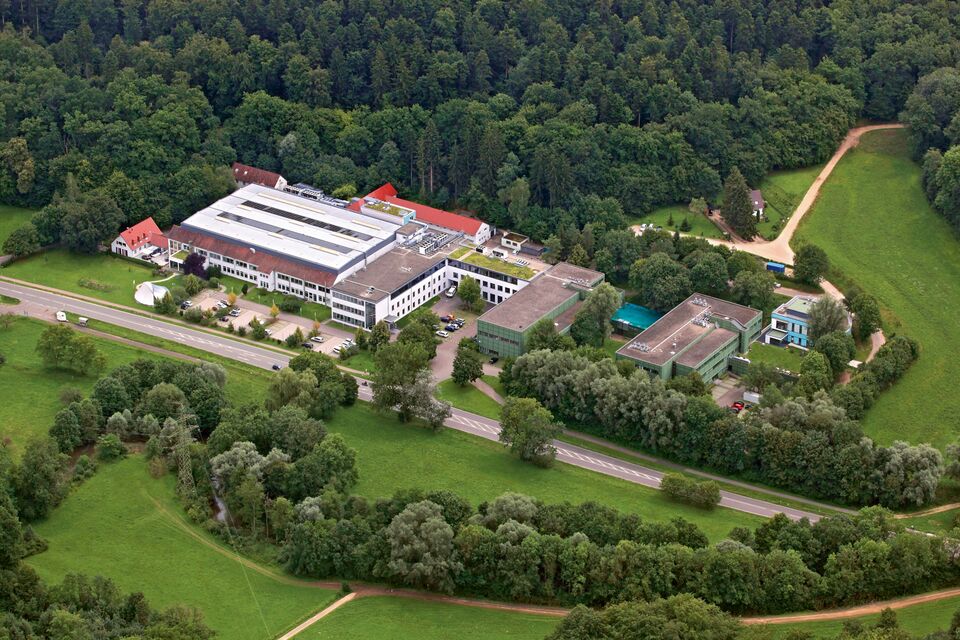
DITF - German Institutes of Textile and Fiber Research Denkendorf
The DITF are Europe’s largest textile research center, with more than 250 scientific and technical employees. As the only textile research institution worldwide, they cover the entire production and value chain of textiles on an area of over 25,000 m². Since 1921, the DITF have addressed all essential textile fields and are among the world’s leading research institutions in their areas of work.
Application-oriented research along the entire textile production chain creates the foundation for product- and technology-driven innovations as well as modern management concepts. These make a significant contribution to the competitiveness and location security of the German and European economy.
German Institutes of Textile and Fiber Research Denkendorf
Prof. Dr. rer. nat. habil.
Michael R. Buchmeiser
Körschtalstraße 26
73770 Denkendorf
Tel. +49 711 9340-101
michael.buchmeiser@ditf.de
www.ditf.de
Core Competencies
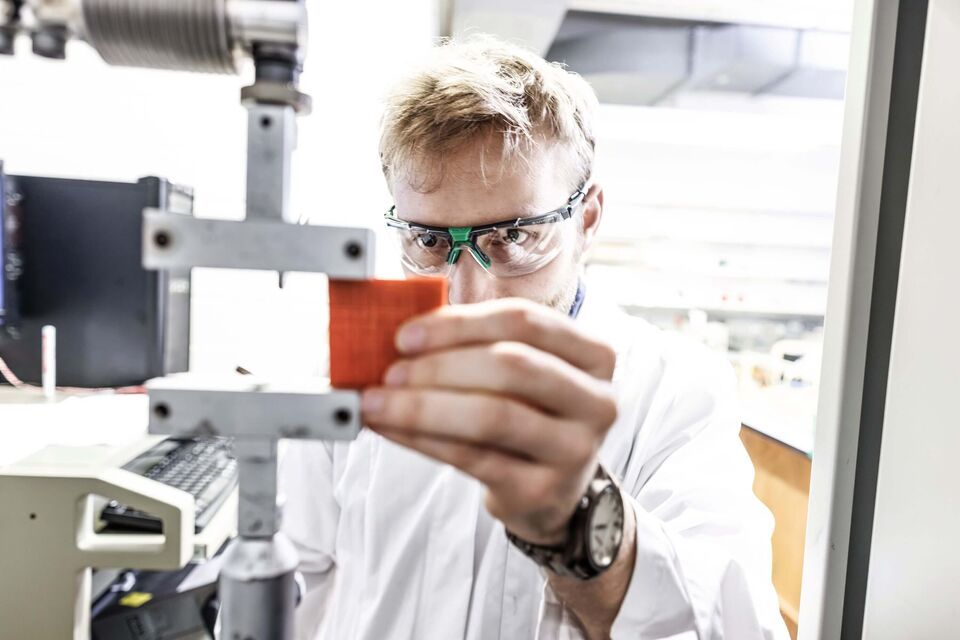
From idea generation to material research, prototype and production process development, pilot production, and testing, we are an important R&D partner for industry and service companies. The DITF conduct research on high-performance fibers and materials, as well as new and adaptive processes in fiber and yarn production, textile finishing, and functionalization. All research areas utilize the latest technologies.
In the DITF competence centers, strengths are bundled and synergies between individual research fields are promoted:
- Biopolymer Materials
- Chemical Fibers & Nonwovens
- High-Performance Fibers
- Polymers & Fiber Composites
- Staple Fibers
- Weaving & Simulation
- Textile Chemistry
- Environment & Energy
Business Fields
The DITF research and develop for practical application. In close and trusting collaboration with industry, market-ready products, processes, and services are created across all textile fields of the future. The interdisciplinary approach at the DITF leads to cross-sectional expertise that drives progress in multiple application areas simultaneously:
- Architecture & Construction
- Health & Care
- Mobility
- Energy, Environment & Resource Efficiency
- Production Technologies
- Apparel & Home Textiles
Intelligent lightweight construction
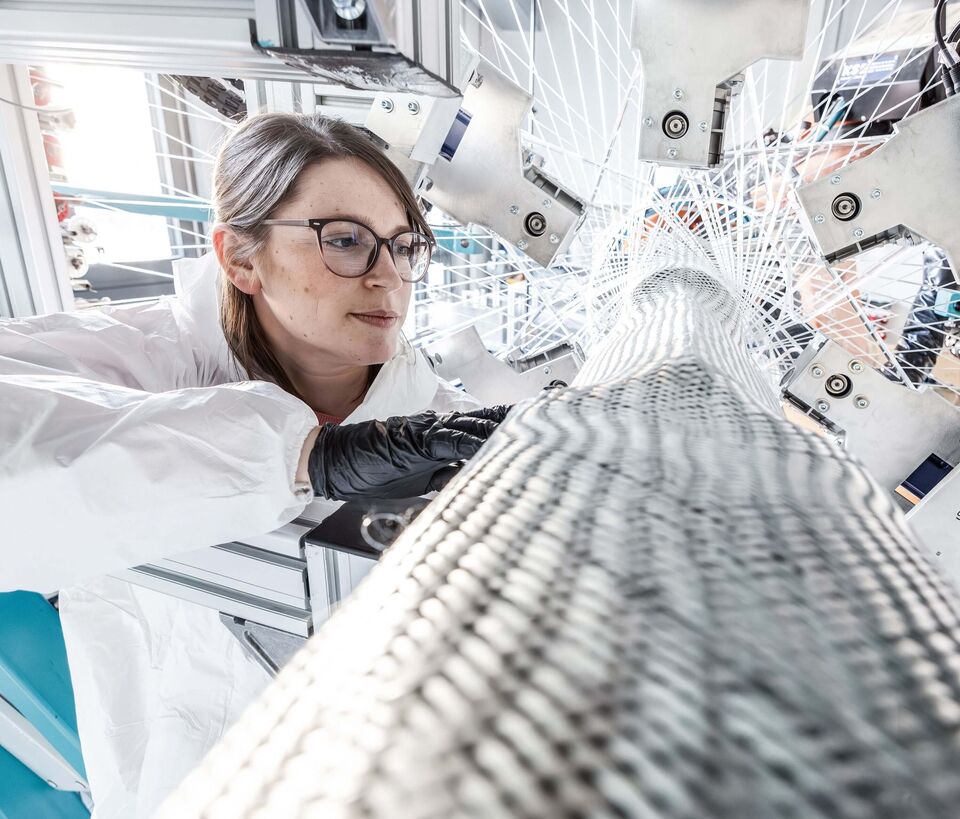
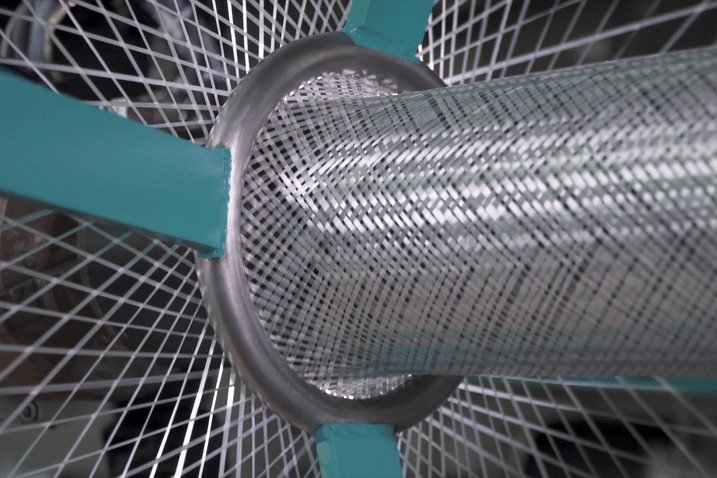
Lightweight construction is a key technology for the energy transition. By using lighter materials in combination with new production technologies, energy consumption in transport, manufacturing industry, and construction is significantly reduced. High-strength and high-stiffness fiber composite materials offer the possibility in lightweight construction to save additional weight or subsequent energy-intensive processing steps through the integration of additional functions. These include, among other things, structurally integrated textile-elastic hinges or the incorporation of sensors for component monitoring. New robot-assisted production technologies enable further weight savings by introducing the fibers into the load paths.
In the development of new composite materials, the DITF also take nature as a model: Biological structures are important sources of inspiration, for example for novel three-dimensional, topology-optimized lightweight constructions or optimized fiber-matrix interfaces.

Fog collectors for drinking water extraction
Around 1.2 billion people do not have secure access to a water source, and this number continues to rise. Taking nature as their model, the DITF have developed a new high-performance textile that filters water from the air. The new 3D textile structure is called "fog collectors" or CloudFisher. The material is tear-resistant and three times more effective than previously used fabrics. In tests, it was able to extract up to 66 liters per square meter per day from the air.
The "CloudFisher" is versatile. "It also provides water for agriculture and forestry and can be used for commercial purposes, such as irrigating vineyards in California or even watering golf courses," explains project leader PD Dr. Thomas Stegmaier.
Textile cascade filter against microplastics
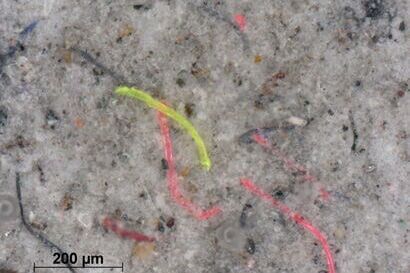
Microplastics are now found almost everywhere, even in remote areas of Antarctica. Through the food chain, they enter the human body. Studies suggest that microplastics can harm human health. When washing textiles made of synthetic fibers, significant amounts of microplastics enter the wastewater and thus the aquatic ecosystem. The German Institutes of Textile and Fiber Research Denkendorf (DITF) have developed a textile-based cascade filter that effectively removes microplastics from washing and rinsing water. This works even at low water pressure. In addition, the system is characterized by a simple design and low maintenance requirements.
The cascade microfilter developed by the Denkendorf research team consists of three stages of three-dimensional textile sandwich composite filter media made of polypropylene fabric and a 3D spacer knit, with the stages having increasingly finer pores. They are designed to filter out microplastic particles down to a size of 1.5 μm.